
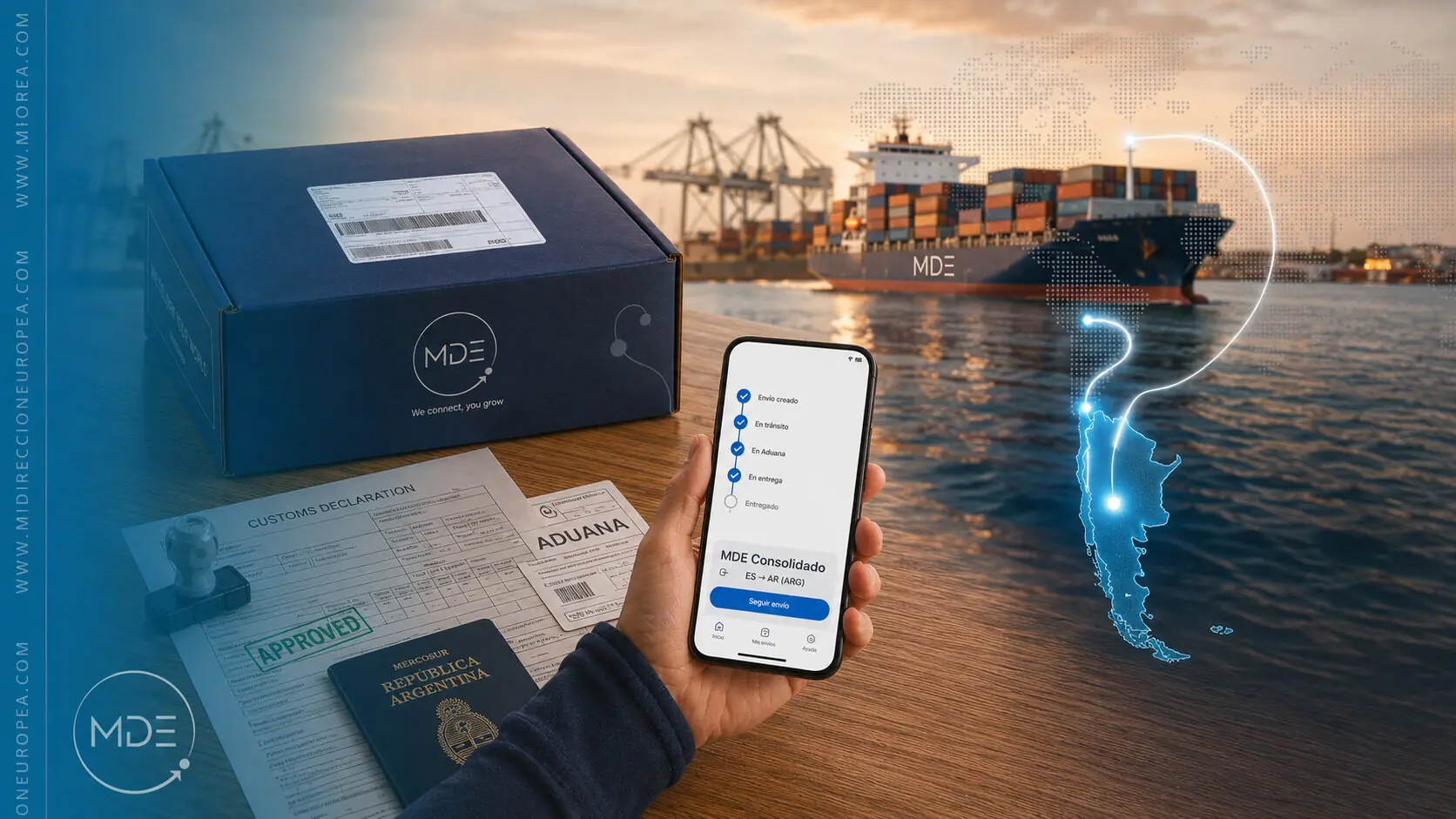
For decades, importing something from China or Europe to Argentina meant the same thing: air freight, tight timelines, and a logistics cost that in many cases ate up half the product's margin.
That started changing in May 2026.
Argentine Customs officially confirmed what a handful of companies had already been quietly testing: maritime courier is legal, can operate under the same simplified regime as air courier, and does not require being a registered importer.
The debate that confirmation opened is still alive. The opportunity it creates — for SMEs, frequent importers and overseas buyers — is real.
What is maritime courier?
Maritime courier is the sending or receiving of packages using sea transport, but classified under the simplified courier regime, not under general importation.
The difference is critical. The courier regime allows:
- Bringing in goods without being a registered importer or having your own customs broker
- Exemption from duties on the first USD 400 FOB per shipment
- The excess is taxed under the general regime, with no former flat 50% tariff (up to USD 3,000 per shipment)
- Door-to-door delivery
What changed in 2026 is the formal answer to a question nobody had asked before: the regulations talk about "courier", but nowhere do they say "air".
Foreign trade specialist Mg. Yanina Soledad Lojo brought that argument to Customs. The technical case is based on RG 5608/2024, which defines the activities of courier services — admission, classification, transport, distribution and delivery — without establishing that they must be performed exclusively by air. The regime's restrictions are tied to FOB value, weight and type of goods. Not the mode of transport.
Customs' response was operational and unambiguous: the sea route is a valid option for courier.
The real problem with air freight
To understand why maritime courier is an important development, you need to understand the problem it solves.
Air freight from China to Argentina can represent between 20% and 40% of the total cost of an imported product in smaller-scale operations. For an SME importing products priced between USD 15 and USD 60 per unit, that's not logistics: it's a cost that destroys the business equation.
Sea freight can be between 3 and 6 times cheaper than air on equivalent routes. With transit times of 30 to 45 days from China and 15 to 25 days from Europe, it was always the logical option for large volumes. The problem was that it didn't exist as an option for small operations under the simplified regime.
That's exactly what changes now.
How it works in practice
Not just any company can offer this service. The operator must be registered as a Postal Service Provider (PSP) — a mandatory requirement to operate within the courier regime, whether air or maritime.
The basic flow is as follows:
- You buy the product abroad (China, Europe, United States) and ship it to the authorized PSP operator's warehouse
- The operator consolidates the sea cargo while maintaining traceability and courier classification from origin
- The container sails to Argentina — directly via Buenos Aires, or with deconsolidation in Uruguay for shipments to the interior of the country
- Customs processes it under the simplified regime, just as with air courier
- The package arrives door-to-door at your address
One point Customs made clear: this is not general cargo that "becomes" courier upon arrival at destination. The courier classification is maintained from origin, with documentation from the authorized postal operator. That is what distinguishes this model from a regular cargo consolidation.
Who it makes sense for (and who it doesn't)
Maritime courier makes sense if:
- You import products from China or Europe with a low or mid unit price — accessories, clothing, consumer electronics, cosmetics, spare parts — where air freight destroys your margin
- You can plan 35 to 50 days ahead
- Your operation is regular and predictable — maritime works best when the purchasing flow is steady
- The shipment value does not exceed USD 3,000 FOB
It's not the option if:
- The product is urgent or perishable
- Delivery time is the central differentiator of your business
- The operation exceeds the limits of the simplified regime (in that case, general importation applies)
The international precedent: the world already does it
Argentina isn't inventing anything. What it's doing is catching up with a practice that in the United States, China and the European Union is already standard.
In those markets, express shipping and cross-border e-commerce systems operate using air, sea or land transport depending on cost, urgency and product characteristics. The mode of transport is not a regulatory restriction for simplified regimes.
What the Argentine market is beginning to adopt — years behind other markets — is the logic that global trade has already normalized: the buyer needs the product, they don't care whether it arrived by plane or by ship.
The regional context: a trend growing across Latin America
Argentina is not the only market where this logic is gaining ground.
The courier and last-mile market in Peru already moves USD 300 million annually and has grown more than 87% since 2019, driven by e-commerce. The new Port of Chancay — the region's most significant maritime infrastructure project — aims to process 3.5 million TEUs per year by 2032, which will reshape the cost equation for all logistics across South America's Pacific corridor.
In Argentina, the logistics and cargo transport market is worth USD 29.74 billion in 2026 and grows at 5% annually. Local e-commerce reached USD 28.5 billion in 2025. Demand for more affordable logistics options is not an emerging trend: it's a structural market need that the traditional air model can no longer meet.
The space no one was occupying (until now)
Today, maritime courier in Argentina is offered by just two companies in Buenos Aires and one in Córdoba. The market is practically empty.
For the foreign trade specialists who drove the debate, this model does not replace air courier or traditional importation. But it fills a gap that didn't exist before: mid-scale operations where air is too expensive and general importation is too complex.
Especially for SMEs, that gap represented a real barrier to business. Customs' operational authorization opens the door for that segment to have, for the first time, a viable alternative.
Frequently asked questions
Can any company operate as a maritime courier?
No. The operator must be registered as a Postal Service Provider (PSP) with the regulatory body. Without that authorization, the operation cannot be classified under the courier regime.
Is maritime transit time compatible with a real business?
Yes, if the operation is planned. Companies that maintain a regular import flow can align their orders with maritime transit times and significantly reduce their logistics costs.
What is the value limit per shipment?
The same as those that apply to air courier: exemption on the first USD 400 FOB and, since Decree 604/2026, taxation of the excess under the general regime instead of the former flat 50% tariff, with a maximum of USD 3,000 per shipment.
Can shipments be deconsolidated in Uruguay for delivery to the interior of Argentina?
Yes. In some cases containers first arrive in Uruguay, are deconsolidated and continue by land to the interior. The key point, according to Customs, is that the entire operation maintains the courier classification from origin to final destination.
Receive your purchases from Europe with MDE
MDE gives you a real postal address in Spain, France, Germany, Italy, Turkey or the United States. You shop at any European or American store, we consolidate your packages and ship them to Argentina and all of Latin America — by air or sea, depending on what makes the most sense for your operation.
Sign up today and get your address in Spain — 14-day trial with money-back guarantee.
Have questions before getting started? Book a call with an advisor and we'll help you plan your purchases.