
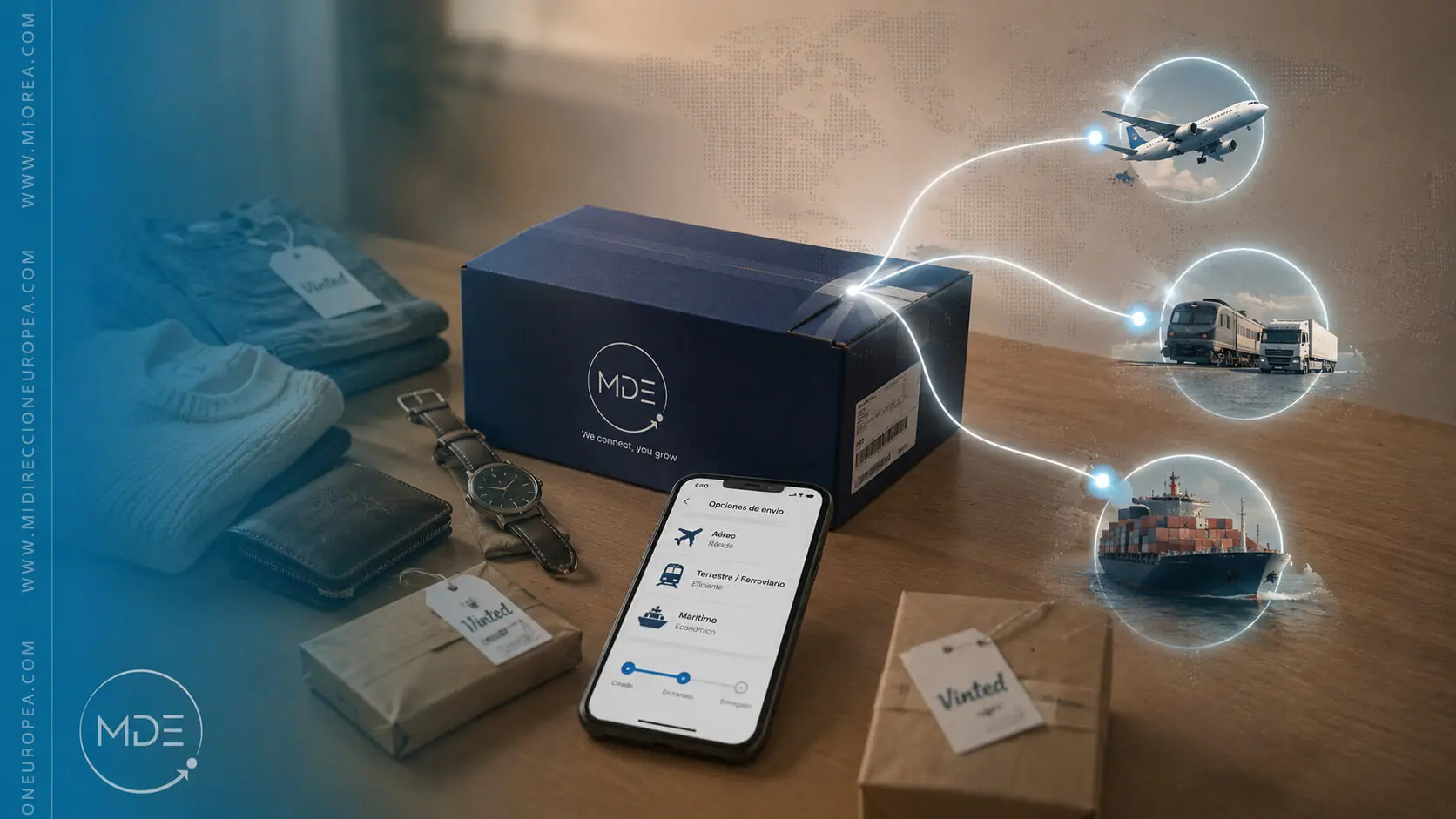
Almost everyone who imports or receives purchases from abroad chooses the wrong transport. Not for lack of judgment, but because nobody explained that air, land and sea don't compete: they complement each other. Choosing the right one can mean paying half the price, or receiving twice as fast. This is the guide that helps you get it right.
For years, receiving a package from Europe, the United States or China came down to one question: air or nothing. Fast, familiar and expensive. So expensive that in many small shipments the freight eats between 20% and 40% of the product's value.
But global logistics no longer works that way. Today there are three real options -- air, land and sea -- and each one has an exact point where it wins. The difference between the person who saves and the one who overpays isn't the rate: it's knowing which one to use in each case.
The three options at a glance
Before going into detail, here is the comparison worth keeping on hand. Ranges are indicative for typical international routes (actual values depend on route, weight and volume):
| Criterion | Air | Land / Rail | Sea |
|---|---|---|---|
| Cost per kg | USD 5 to 10 | Intermediate (~1/5 of air on China-Europe rail) | USD 0.10 to 2 |
| Transit time | 1 to 7 days | 3 to 7 days (regional) / 12 to 18 days (China-Europe rail) | 20 to 45 days |
| Best for | Urgent, lightweight, high value | Medium distances and connected corridors | Volume, weight, no rush |
| CO2 footprint (g/ton-km) | 500 to 1,000 | 20 to 150 | 10 to 20 |
| % of world trade | <1% of volume, +35% of value | Key in land corridors | ~90% of volume |
That last figure says it all: planes carry less than 1% of what the world ships, but more than 35% of its value. Ships do exactly the opposite. They're not rivals. They're different tools for different jobs.
Air courier: when time is worth more than money
What it's for. It's the king of urgency and value per kilo. A shipment leaves Europe or the United States and arrives at its destination within days. That's why it moves electronics, documents, commercial samples, critical spare parts, branded cosmetics and everything that can't wait. The 2026 data confirms it: goods linked to artificial intelligence (chips, servers, components) represented 53.5% of the value of air cargo, but only 7% of its volume. When something is expensive, small and urgent, it flies.
Advantages: unbeatable speed, high security, less handling, ideal for fragile or high-value products.
Disadvantages: the most expensive mode (up to 12-15 times sea), penalized by fuel surcharges, and by far the highest carbon footprint.
Choose it when: the product is urgent, weighs little, is worth a lot, or delivery speed IS your competitive advantage.
Sea courier: when volume rules
What it's for. It's the backbone of global trade: around 90% of everything that moves on the planet travels by water. Its logic is simple: the larger and heavier the shipment, the cheaper it becomes per unit. For bulky, non-urgent cargo it can save between 70% and 90% compared to air.
Advantages: the lowest cost per kilo on the market, near-unlimited capacity, the smallest CO2 footprint (up to 47 times less than air per ton-km), and — a key development in the region — now authorized under the simplified courier regime in markets like Argentina.
Disadvantages: slow (20 to 45 days), exposed to port congestion and route crises like the Red Sea situation, which pushed several transits to Europe past 45 days.
Choose it when: you import volume or weight, can plan 35-50 days ahead, and air freight is destroying your margin.
Land and rail: the middle ground almost nobody looks at
What it's for. Here's the best-kept secret of 2026. Between expensive air and slow sea, a third option emerged that combines the best of both: the China-Europe freight train. It covers the Eurasian corridor in 12 to 18 days — half the time of sea — at around one fifth the cost of air. It's no coincidence that inquiries about rail bookings jumped 40% in a single quarter.
For medium distances and within Europe, trucks remain unbeatable: 3 to 7 days door-to-door, complete flexibility and the only option that doesn't depend on ports or airports.
Advantages: cost-time balance, true door-to-door delivery, low carbon footprint (trains emit up to 20 times less than planes), and immune to maritime route crises.
Disadvantages: limited to corridors with connected infrastructure; doesn't reach all destinations and can't cross oceans on its own.
Choose it when: you want faster than sea without paying air prices, or your shipment moves within a well-connected land corridor (continental Europe, China-Europe route).
The golden rule: how to choose in 10 seconds
If it's urgent and lightweight -> air.
If it's bulky, heavy and you can wait -> sea.
If you want the sweet spot between cost and speed -> land / rail.And the secret used by those who save the most: they almost never choose just one. They combine. That's called multimodal transport, and it's where the entire industry is heading.
The 2026 trend: the world stopped choosing a single mode
The big transformation this year isn't that one mode is beating another. It's that companies stopped thinking "air vs sea" and started thinking in combinations. A product can cross the ocean by ship, unload at a European port and complete the last mile by truck. Or travel by train to a hub and only fly the urgent leg.
Three forces explain the shift:
- Resilience. The Red Sea crisis showed that depending on a single route is a risk. Having alternatives moved from luxury to strategy.
- Sustainability. Shifting one ton-kilometer from plane to ship cuts emissions by up to 47 times. More and more buyers and businesses factor this in.
- Cost. With margins getting tighter, choosing the right mode stopped being an operational detail: it's the difference between making money or losing it on the operation.
Who's adopting it
The United States, China and the European Union have been running multimodal for years: they choose air, land or sea based on cost, urgency and product type, without the mode of transport being a regulatory obstacle. What's changing now is that Latin America is catching up.
Argentina just officially authorized maritime courier under the simplified regime. Peru already moves USD 300 million annually in courier and last-mile logistics — growth of more than 87% since 2019 — and the new Port of Chancay aims to reshape all of South America's Pacific logistics. The regional conclusion is clear: demand for options cheaper than air isn't a trend, it's a structural need that the old model can no longer meet.
The surprising fact: the cheapest mode is also the cleanest
We tend to assume that saving money means giving something else up. In logistics it works the other way. Sea freight isn't just the cheapest mode: it's also the one with the smallest carbon footprint — between 10 and 20 g of CO2 per ton-kilometer, versus 500-1,000 for planes. Meaning: the shipment that saves your wallet is, almost always, the same one that saves the planet. Rarely do incentives align so well.
How MDE helps you choose right
Here's the real problem: most buyers have no way to compare modes, consolidate packages or decide what makes sense for each shipment. They have to choose blind. That's exactly what we solve.
MDE gives you a postal address in your name in Spain, France, Germany, Italy, Turkey or the United States. You shop at any European or American store as if you were a local, and we:
- Consolidate all your packages into one shipment, so you pay once, not ten times.
- Compare modes — air or sea — and recommend the one that makes sense for each operation.
- Repack applying the volumetric weight rule, so you don't pay for air.
- Ship to Latin America and worldwide with smart tracking and end-to-end traceability.
You stop choosing blind. You choose with data.
Create my free account — 14-day trial with money-back guarantee. Questions? Book a call with an advisor.
Frequently asked questions
What's cheaper, air or sea shipping?
Sea, almost always. It can cost between 4 and 15 times less than air per kilo. The trade-off is time: 20 to 45 days versus 1 to 7 for air.
When does it make sense to pay for air even though it's more expensive?
When the product is urgent, weighs little and is worth a lot, or when speed is your commercial advantage. For small, high-value shipments, the extra air cost is justified.
Is there an option between air and sea?
Yes: land and rail. The China-Europe train delivers in 12 to 18 days at around one fifth the air cost, and trucks are unbeatable for medium distances within the same continent.
What is multimodal transport?
It's combining two or more modes in a single shipment — for example, sea plus truck — to optimize cost, time and resilience. It's the dominant trend in 2026.
How does MDE help me choose the right mode?
We receive your purchases at our warehouses, consolidate them and recommend the shipping mode — air or sea — that best fits each operation, so you don't overpay.