
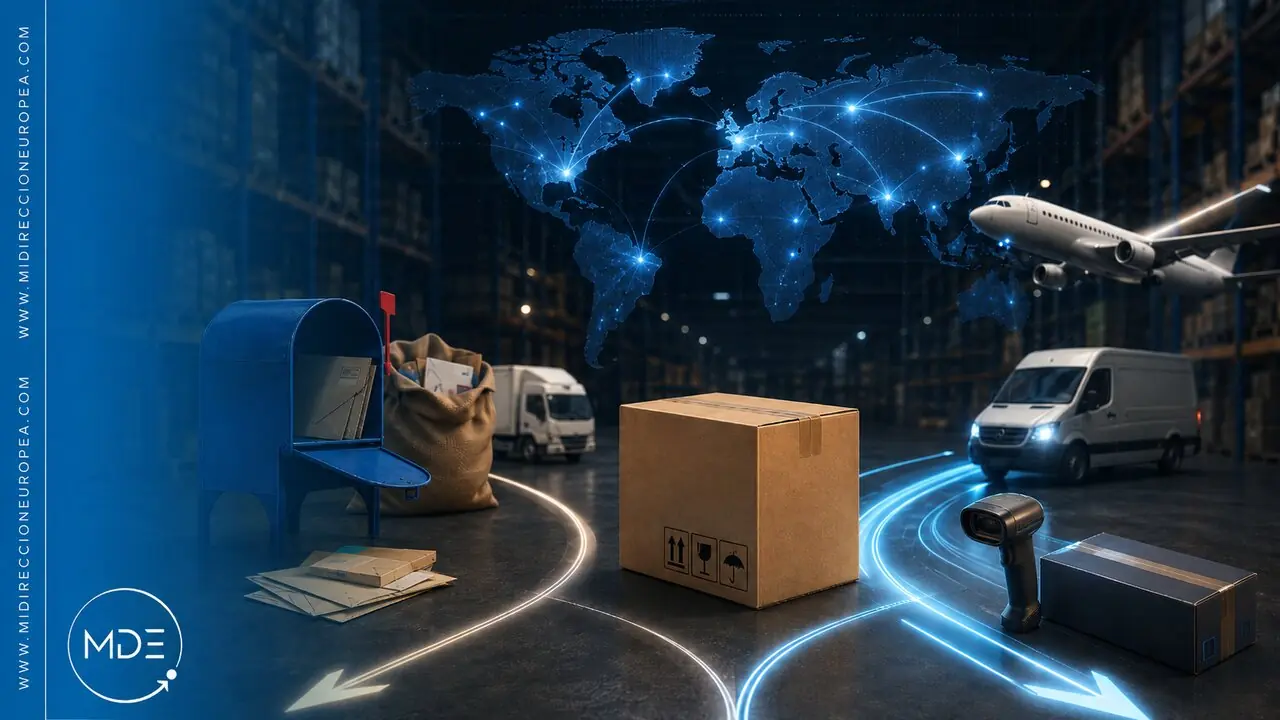
Two identical packages leave Spain for your country on the same day. One arrives in 4 days, with minute-by-minute tracking and a heads-up on what you owe at customs. The other takes five weeks, sits "in transit" with no updates, and shows up held without anyone letting you know. You didn't buy different things: the difference is in how it was shipped, by postal mail or by international courier. Understanding this difference is what separates a smooth delivery from a headache. Here's the complete, 2026-updated guide: what each one is, the middle ground almost nobody tells you about, real transit times by region, how much they cost, how they behave at customs, tracking, insurance, incidents and a matrix to choose well. Whether you live in Latin America, the United States, the United Kingdom or Australia.
What international postal mail is
Postal mail is the public network of national operators connected by the Universal Postal Union (UPU). Your package leaves the origin operator (for example Correos in Spain) and, at destination, it's delivered by your country's postal operator: Correo Argentino, Correos de Mexico, Correios (Brazil), CorreosChile, Serpost (Peru), 4-72 (Colombia), Correo Uruguayo, or USPS, Royal Mail and Australia Post if you're in the US, the UK or Australia. It's the cheapest option for small, light packages, but also the slowest and with the least visibility: nobody "owns" the shipment end to end; instead it passes from one postal administration to another.
What an international courier is
An international courier (or express integrator) is a private operator that controls the shipment from start to finish: pickup, its own air transport, customs clearance and delivery to your door. The big ones are DHL Express, FedEx and UPS (TNT is now part of FedEx). Because a single party is responsible for the entire chain, the package moves faster, with detailed tracking and priority at customs. It costs more, but it rarely gets "lost in limbo".
The middle ground almost nobody explains: EMS and economy services
It's not all black or white. There's a middle ground:
- EMS (Express Mail Service): it's the express service of the postal system itself (in Spain, products like Paq Premium international). Faster than standard mail and cheaper than a courier, though without the full traceability of DHL or FedEx.
- Courier economy services: many couriers offer "economy" rates that combine their transport with final delivery by the local postal operator. Cheaper than pure express, a bit slower.
Knowing this middle ground exists lets you fine-tune price and time on each shipment instead of overpaying or over-waiting.
Postal mail vs international courier: full comparison
| Criterion | Postal mail | International courier |
|---|---|---|
| Transit time | 2 to 6 weeks (or more) | 2 to 5 business days |
| Customs priority | Low: postal queue, slow and unpredictable | High: express clearance, the courier acts as agent |
| Tracking | Basic, "freezes" at borders | Event by event, in real time |
| Price | Cheaper (ideal for small packages) | More expensive, but fast and reliable |
| Responsibility | Split among administrations | A single party responsible for the whole chain |
| Insurance | Limited | Coverage and claims handling |
| Incidents | More delays and packages with no updates | Low rate; and if it happens, there's someone to claim from |
| Restrictions | Strict: no liquids or dangerous goods, smaller boxes | More flexible: large boxes and special goods with documentation |
| Ideal for | Cheap, light and not in a hurry | Urgent, valuable, fragile or with tracking |
Average transit times by region
Times depend on origin, destination, customs and the season, but on average, from Europe:
- To Latin America (Argentina, Mexico, Chile, Colombia, Peru...): courier 3 to 6 business days; postal mail 3 to 6 weeks.
- To the United States and Canada: courier 2 to 4 days; postal mail 1 to 4 weeks.
- To the United Kingdom and the rest of Europe: courier 1 to 3 days; postal mail 1 to 3 weeks.
- To Australia and Oceania: courier 3 to 6 days; postal mail 3 to 6 weeks.
During peak season (Black Friday, Christmas) or with a customs hold, postal mail can exceed a month. The courier also slows down, but much less.
How much each one costs: when postal wins and when courier wins
The rule is simple: postal mail wins on price for small, light packages with no urgency; the courier wins on time, tracking and security. But there's a nuance many people overlook: on packages with some weight or volume, the price gap narrows, and since the courier avoids weeks of waiting and holds, it's often worth paying a bit more. Also, if you consolidate several purchases into a single shipment, the courier's per-product cost drops considerably. The best way to decide isn't to guess: it's to compare price and time for the specific shipment before sending it (below we tell you how).
Customs: why postal gets stuck and courier doesn't
Here's the real breaking point. With a courier, clearance is express and the company itself acts as agent before customs, with the documentation (invoice or proforma) ready; the package moves forward and you know what to pay. With postal mail, your package enters your country's postal customs queue: slow, not very transparent, and with holds that take weeks with no clear notice.
In both cases taxes are set by your country's law, not by the carrier. Each country has its own allowance or "de minimis" (the value below which you pay nothing or pay little): for example, Argentina raised it to USD 400 with Decree 604/2026, and in the US, the UK or Australia their own rules apply, which are worth reviewing. Also note that in some countries postal mail and courier are not taxed the same, and postal can be cheaper in taxes. Example, Mexico (Reglas Generales de Comercio Exterior 2026): by postal mail, up to USD 50 per recipient pays no import taxes (unless the goods are subject to non-tariff restrictions) and up to USD 1,000 a single 19% flat rate applies; by courier from Europe a 33.5% global rate applies, which replaces the tariff and VAT. Which route is used depends on weight, size and the service chosen. What does make the difference is documentation: a well-made proforma speeds up clearance and avoids most holds, whether your package goes by post or by courier.
Tracking: what you see with each one
With a courier you see every event: picked up, at the hub, departed the country, arrived at destination, at customs, out for delivery, delivered. With postal mail, tracking usually shows you little and "freezes" when crossing borders, right when you most want to know where it is. It's the number one source of anxiety for the international shopper. That's why we developed our AI-powered smart tracking, which unifies and translates the statuses so you always know what's happening.
Insurance and responsibility if something goes wrong
If a package is lost or arrives damaged, the difference is huge. The courier has a single party responsible for the whole chain, traceability and insurance, so filing a claim is straightforward. With postal mail, responsibility is split among administrations and insurance is limited, so a claim is slower and with fewer guarantees. For valuable shipments, declare the contents properly: that's what lets the package travel insured for its real value.
What you can ship: liquids, batteries and box size
This is a difference that surprises many shoppers. Postal mail is quite a bit more restrictive than a courier:
- It doesn't carry liquids or dangerous goods (perfumes and cosmetics with alcohol, aerosols, flammables, chemical products).
- Lithium batteries: the post restricts or bans loose lithium batteries and power banks; batteries installed inside a device (phone, laptop) are usually accepted. Couriers do carry them with the correct declaration and packaging, under dangerous goods regulations.
- Box size and weight: the post has stricter limits and often won't accept large or bulky boxes.
- Pallets and large shipments: for bulky or wholesale orders, the courier and freight allow shipping on pallets; postal mail doesn't go that far.
Couriers accept larger, heavier boxes, pallet shipments and special goods (including lithium batteries and some dangerous ones) with the right packaging and documentation. So if your purchase is a perfume, a liquid product, a power bank, a device with a lithium battery, a bulky box or even a pallet shipment, the courier or freight is usually the only viable route. When in doubt, ask us before buying and we'll tell you how to ship it.
Dangerous goods (DG): what it applies to, how they're handled, protocol and times
DG (Dangerous Goods) are dangerous goods: items that, by their nature, have special rules for travel, especially by air. In air transport they're regulated by IATA (DGR regulations), and that's why neither postal mail nor a courier moves them "just like that".
What it applies to (the most common in online shopping):
- Lithium batteries (Class 9): loose or inside equipment. Typical UN numbers: UN3480/UN3481 (lithium-ion) and UN3090/UN3091 (lithium metal). Includes power banks.
- Flammable liquids (Class 3): perfumes and cosmetics with alcohol, nail polishes.
- Gases and aerosols (Class 2): deodorants and pressurized sprays.
- Corrosives, strong magnets and similar: depending on the product.
How it's handled (the protocol):
- Classify the item: UN number, correct name and hazard class.
- UN-approved packaging and labeling with the applicable hazard marks.
- Documentation: the shipper's dangerous goods declaration (or the specific lithium battery marking) and, when possible, use Limited Quantity (LQ) or Excepted Quantity (EQ) for small shipments. That's how many perfumes and cosmetics travel.
- DG-certified courier (DHL, FedEx and UPS have a dangerous goods program). Postal mail almost never accepts DG.
Times: a DG shipment usually needs an additional review and acceptance at the courier's hub, which can add one or two days to transit. If the documentation or packaging is wrong, the package is rejected (delay or return), so getting it right the first time is what saves time. Also, certain items or quantities can't fly on certain routes.
With MDE, if your purchase is DG (a battery, a perfume, a power bank), we detect it and tell you how to ship it the right way, with the proper documentation and packaging. When in doubt, ask us before buying.
Typical incidents (and how to resolve them)
- Frozen tracking: a postal mail classic. Solution: courier with real-time tracking, or our AI tracking.
- Customs hold with no notice: declare contents and value properly; a correct proforma avoids most of them.
- Peak-season delays: buy with some lead time before Black Friday and Christmas.
- "Lost" package: with a courier there's traceability and insurance; open the claim as soon as possible. With the post, build your claim with the tracking number and the invoice.
- Incomplete address: always double-check your destination address; many returns come from a wrongly entered detail.
The companies: who's who
- International express integrators / couriers: DHL Express, FedEx, UPS (and TNT, now part of FedEx). They control the whole chain with their own network and planes; they're the ones we use for express shipments.
- Aramex: a Dubai-based courier operating in more than 65 countries, majority-owned since July 2025 by ADQ, Abu Dhabi's sovereign fund, with 63% of the shares. Strong in the Middle East and Asia, not in Latin America from Europe. We use it as an economy lane from our US warehouse to Spain.
- Deutsche Post / DHL Group: three different things under one brand. DHL Express is the courier with its own network and planes. DHL Paket and DHL Parcel are the parcel services of the German post (Deutsche Post), delivered at destination by the local post or a partner. And DHL eCommerce is the economy lane that also ends up with your national post. If your tracking says "Deutsche Post DHL: DHL Paket International", it is not DHL Express: it is the postal lane, cheaper and slower.
- Freight forwarders (cargo, volume and pallets): DSV (Panalpina, DB Schenker), Kuehne+Nagel, DHL Global Forwarding, Expeditors, CEVA Logistics. They book space on planes and ships and handle customs and documentation.
- Couriers and parcel carriers in Europe: SEUR (DPD group), GLS, MRW, Chronopost, Zeleris (a Telefónica subsidiary, with its sale to OnTime agreed in 2026), Nacex, Envialia, CTT Express.
- Correos Express: the urgent-parcel subsidiary of the Correos Group, separate from Correos itself. It runs its own network of 71 branches (60 in Spain and 11 in Portugal), reaches 100% of Spanish municipalities and its products are Paq10, Paq14, Paq24, Paq48 and Paq72, with 24-hour delivery on the mainland. For the international shopper its usual role is different: it is the carrier many stores use to deliver your purchase to our warehouse. If your tracking starts with Correos Express and continues with another company, that is the normal handover from the domestic leg to the international one.
- Cross-border e-commerce consolidators: they group light shipments from many stores and inject them into the destination post or courier, often relabelling the capacity of the big players. Asendia is the joint venture of La Poste and Swiss Post created in 2012; its e-PAQ Select product is tracked and supports prepaid duties (DDP), and if your tracking passes through Asendia, the last leg will be done by your national post. Spring GDS is the PostNL subsidiary with last-mile delivery in 190 countries: the "Global Express International" name that shows up in some trackings is usually this. Others: Landmark Global, Cainiao, 4PX, YunExpress.
- Couriers and post in China and Hong Kong: SF Express, J&T Express, Kerry Logistics; on the postal side, China Post / China EMS and Hongkong Post.
- Operators in the United States: USPS (postal mail), UPS and FedEx (couriers) and regionals like OnTrac (formerly LaserShip). It's the origin of our Tax Free warehouse.
- Origin postal operators (Europe): Correos (Spain) with three parcel products: Paq Light Internacional (up to 2 kg, tracked, no compensation), Paq Standard Internacional (up to 30 kg) and Paq Premium Internacional (up to 30 kg, guaranteed date and coverage included; it is the Spanish EMS). Fresh fact: since 1 January 2026 Correos no longer accepts goods as Certificado Internacional, only documents. Česká pošta is the public post of the Czech Republic, which carries the light shipments from our Czech and German warehouses: registered Priority mail for light items, Priority parcel up to 30 kg and EMS Czech as postal express. Royal Mail (United Kingdom), with International Tracked, is the postal lane from our British warehouse. And Deutsche Post, with DHL Paket International, the German one.
- United Kingdom: Royal Mail, Parcelforce and Evri. Royal Mail is the British post and since 2025 belongs to the EP Group of Czech businessman Daniel Křetínský, the first foreign owner in its history, with a golden share held by the UK Government so that the headquarters stay in the UK. Its international products are International Tracked and International Tracked & Signed, which is what you will see in your tracking when your purchase leaves our British warehouse. Parcelforce Worldwide is Royal Mail's parcel division, with its own network and Global Priority as international express. Evri, called Hermes UK until 2022, is the country's largest private parcel carrier, with more than 800 million parcels a year; we use it as an economy lane from the UK to Spain and Europe. For urgent items, FedEx and UPS.
- France: La Poste, Colissimo, Chronopost and Mondial Relay. La Poste is the French post and Colissimo its standard parcel brand, delivering in one to three working days within France. Chronopost is the express subsidiary of the same group through Geopost, with its own network and hubs and next-day delivery. Mondial Relay is the pick-up point network, around 12,000 in France, owned since July 2021 by Poland's InPost. For you, these are the names that carry your purchase from the French store to our warehouse; the international leg from France leaves with MRW, Zeleris, Correos, UPS or FedEx, so you will not see Colissimo on the way to your country.
- Destination postal operators: Correo Argentino, Correos de Mexico, Correios (Brazil), CorreosChile, Serpost (Peru), 4-72 (Colombia), Correo Uruguayo; and USPS, Royal Mail or Australia Post depending on your country.
Having them pinned down helps you know who has your package on each leg and whom to claim from if something gets stuck.
Which carrier we use from each warehouse
Not every carrier leaves from every location. This is what you will see in your tracking depending on which MDE warehouse your purchase ships from:
- Spain (Barcelona and Valencia): Correos Paq Light and Paq Premium Internacional for light, non-urgent parcels; UPS, FedEx and DHL Express for urgent or valuable ones; and Zeleris Internacional Express as an express alternative. Most light shipments to Mexico leave with Correos today.
- United States (Tax Free warehouse): DHL Express, UPS and FedEx to Latin America and Europe; Aramex as an economy lane to Spain; and Asendia e-PAQ Select for light parcels to some Latin American destinations.
- United Kingdom: Royal Mail International Tracked for light parcels, Evri Europe Standard as the economy lane to Europe, and FedEx or UPS for urgent ones.
- Germany and Czech Republic: Deutsche Post DHL Paket International and Česká pošta (Priority mail and Priority parcel) as the postal lane, and FedEx as express.
- France and Italy: FedEx Economy to the Americas, European parcel carriers (MRW, GLS, Zeleris, Ontime) to Spain and Portugal, and Correos Paq Light or DHL Paket for light parcels.
In the quoter you see exactly which carrier and which transit time each option has before you decide.
Why does my shipment switch companies? (the "Zeleris becoming DHL" case)
It's normal to see your package start with one company and end with another: it leaves as Zeleris and then shows up as DHL, passes through a name like "Global Express" or is moved by DSV. It's not an error: that's how international logistics works. No single operator covers every route end to end cheaply on its own, so they combine networks:
- Subcontracting (handoff): a courier or local agent (like Zeleris, a Spanish courier, a Telefónica subsidiary whose sale to OnTime was agreed in 2026) picks up the package and subcontracts the international leg to an integrator like DHL; or the other way around, DHL does the flight and the final delivery is done by the post or a local courier. That's why tracking "changes hands".
- Consolidators and capacity resale: many sellers use consolidators that buy volume from DHL, FedEx or UPS and relabel it under their own brand (hence names like "Global Express", which in practice is usually Spring GDS, the PostNL subsidiary).
- Forwarders: companies like DSV (which absorbed Panalpina and DB Schenker and is the largest freight forwarder in the world), Kuehne+Nagel or DHL Global Forwarding don't always have their own planes on every route: they book space on airlines and carriers and handle customs, documentation and insurance. They're the ones that move large cargo and pallets.
Who's who in the ecosystem:
- Integrator / express courier (DHL Express, FedEx, UPS): controls the whole chain with its own network and planes.
- Forwarder (DSV, Kuehne+Nagel, DB Schenker, DHL Global Forwarding, Expeditors): organizes transport by air, sea, road or rail and subcontracts; ideal for volume, cargo and pallets.
- Regional and last-mile courier or consolidator (Zeleris, SEUR/DPD, GLS, Correos Express, MRW, and consolidators like Asendia or Landmark Global): they pick up, group, deliver the last leg or resell the capacity of the big ones.
- Postal mail (Correos, Correo Argentino, USPS...): the public network, often the last link in delivery.
What matters to you isn't how many hands touch the package, but that it arrives with tracking and priority. With MDE the shipment goes via routes with traceability and, if something gets stuck, we know whom to claim from on each leg.
Per-package locker, route consolidator or direct courier: not the same thing
When you compare prices between companies shipping from Spain to Latin America, look at the model before the rate, because there are three very different ones and they get mixed up all the time.
Per-package, per-customer service. This is the model of MDE and also of forwarders like Pakedia: every package is handled individually. You decide when it ships, with which carrier (Correos, UPS, FedEx, DHL Express, Zeleris) and how urgently. You can ask for photos, repacking or consolidating several purchases into one shipment, and the tracking is for your package, not for a batch. The difference between them lies in the available origins, the language and the customs handling: MDE gives you 10 countries in one account, Pakedia only Spain. We compare them in detail in our package forwarder comparison.
Route consolidators. This is the model of Globalexs, GTL Express in Peru, Servienvia, Tealca, Alaslatinas, Eurodirecto or Mundibox, and of many companies born to serve the migrant community: they gather packages from hundreds of customers and dispatch them together on fixed departures to specific routes, usually once a week and, for some destinations, once a month. By filling the aircraft hold or the container, the price per kilo drops, which is why they tend to win on heavy boxes. In exchange, your package waits for the next departure, can only go to the routes they operate and the service is designed around the consignment, not your individual shipment: little room to choose carrier, date or tailored handling. Globalexs, for example, advertises weekly departures from Barcelona and monthly ones to destinations such as Nicaragua; Tealca publishes one air departure a week and one sea departure a month to Colombia, and Mundibox two flights a week to Peru. Several of them also offer a "locker" for online purchases, but the shipment still waits for the scheduled departure: the difference is not in the word, but in who decides when your package leaves and with which carrier.
Direct courier. DHL Express, FedEx or UPS take a package from A to B in days, but they do not give you an address in Spain to receive purchases, nor consolidate, nor check what arrives. They are the transport, not the locker. In fact, the two previous models travel on top of them or on the postal network.
None is better at everything. If you are sending 20 kg of clothes and food to your family and do not mind it taking three or four weeks, a consolidator may work out cheaper. If you bought a phone, limited-edition sneakers or a spare part you need now, you want it to leave today, with the carrier you choose, with its own tracking and someone accountable for that package: that is the per-package model.
| Per-package locker (MDE, Pakedia) | Route consolidator (Globalexs, GTL Express and similar) | Direct courier (DHL, FedEx, UPS) | |
|---|---|---|---|
| When it ships | When you decide | On the next scheduled departure, weekly or monthly | When you hand it over |
| Destinations | Worldwide | Fixed routes, almost always Spain to Latin America | Worldwide |
| Price | Medium; drops a lot when consolidating | Low per kilo on heavy boxes | High |
| Time | That of the carrier you choose; 3 to 6 days on express | Wait for the departure plus transit; counted in weeks | 2 to 5 days |
| Tracking | Of your package | Of the consignment, depending on the company | Of your package, event by event |
| Service | Receiving purchases, photos, repacking, consolidation, assisted customs | Standard, designed for the batch | Transport only, no address to shop with |
Decision matrix: what to choose in each case
- Electronics, phones, Apple: courier. High value, you want tracking and insurance.
- Brand-name fashion, footwear, car parts, collectibles: courier or EMS. Medium-high value and often in a hurry.
- Gifts with a date (birthdays, Christmas): courier. Don't gamble on the post's weeks.
- Documents and small items with no urgency: postal mail or EMS. You save and it's no problem if it's slow.
- Several purchases at once: consolidate and ship by courier: the per-product cost drops a lot.
- Heavy box for the family, no rush and to a common route (Ecuador, Peru, Colombia): a route consolidator may be the cheapest. Compare it in our quoter with a consolidated shipment via Correos Paq Premium before deciding.
See in a minute how it works:
How MDE helps you
With your locker at MDE you shop in any store and decide how to receive it. For light parcels with no rush we use Correos Paq Light and Paq Premium Internacional, with tracking; for urgent or valuable ones, FedEx, UPS and DHL Express, with real-time tracking and a proforma for smooth customs clearance. Every package ships when you decide, not on a weekly departure. In the quoter you see the price and time of each option before sending and choose the one that suits you best; if you bought from several stores, consolidation combines everything into a single shipment and lowers the per-product cost. Torn between carriers? Check out our comparison of the best forwarding companies and the guide to air, land or sea courier.
Create my locker now and ship with courier, tracking and customs priority.
Frequently asked questions
What's the difference between postal mail and international courier?
Postal mail is the public network of national operators (Correos, Correo Argentino, USPS...): cheaper but slow, with basic tracking and no customs priority. The international courier (DHL, FedEx, UPS) is private and express: more expensive, but fast, with real-time tracking, insurance and customs priority.
How long does an international shipment take by post versus a courier?
From Europe, a courier usually delivers in 2 to 6 business days depending on the country; postal mail, between 1 and 6 weeks, and longer in peak season or with a customs hold.
What is EMS and when is it worth it?
EMS is the express service of the post itself (in Spain, Paq Premium international): faster than standard mail and cheaper than a courier. A good middle ground for shipments in a bit of a hurry but on a tight budget.
Does the courier avoid paying customs?
No. No service exempts you from your country's taxes; the allowance is set by law. In some countries postal mail is taxed less than a courier (for example, in Mexico, by postal mail up to USD 50 pays no taxes). The courier makes clearance faster and more transparent, and a correct proforma avoids holds.
Why does my postal package stop getting updates?
Postal tracking usually freezes when crossing borders and entering the customs queue, which moves with no priority. With a courier or smart tracking you know where it is at every moment.
What happens if my package is lost or damaged?
With a courier there's a single responsible party, traceability and insurance, so the claim is straightforward. With the post, responsibility is split and insurance is limited. Declare the value properly so it travels insured.
Which companies are couriers and which are postal mail?
Courier: DHL Express, FedEx, UPS and Aramex (and SEUR, GLS, Correos Express, MRW, Zeleris, Chronopost, Parcelforce and Evri in Europe). Postal mail: Correos, La Poste (Colissimo), Deutsche Post (DHL Paket), Česká pošta, Royal Mail, Correo Argentino, Correos de Mexico, Correios, USPS, Australia Post. Consolidators that travel on top of both: Asendia and Spring GDS.
Why does my package pass from one company to another, like from Zeleris to DHL?
Because international logistics combines networks: a courier or consolidator (for example Zeleris) picks up the package and subcontracts the international leg to an integrator like DHL, or a forwarder like DSV books space and another company does the final delivery. It's normal and doesn't mean there's a problem; what matters is that it arrives with tracking.
Can I ship perfumes, lithium batteries, power banks or pallets?
By postal mail, normally not: it doesn't accept liquids or dangerous goods, restricts loose lithium batteries and power banks, and has stricter box-size limits (no pallets). By courier or freight it is possible in many cases, with the right packaging and documentation, including bulky pallet shipments. When in doubt, ask us before buying.
What are dangerous goods (DG) and how long do they take?
They're items with special air transport rules (IATA DGR): lithium batteries and power banks, perfumes and flammable liquids, aerosols and corrosives. They're shipped by a DG-certified courier, with UN-approved packaging, labeling and declaration; many perfumes travel as Limited Quantity. The DG review usually adds one or two days to transit.
How do I choose between post and courier with MDE?
In the quoter you see the price and time of each option before sending, and you choose the one that suits you best based on urgency, value and destination. Consolidating several purchases makes the courier cheaper.
Is Deutsche Post the same as DHL?
Not quite. They belong to the same group (DHL Group, formerly Deutsche Post DHL), but DHL Express is the courier with its own network and DHL Paket is the German post's parcel service, delivered at destination by the local post. If your tracking says "Deutsche Post DHL: DHL Paket International", it travels by the postal lane: cheaper and slower than DHL Express.
Are Aramex and Asendia couriers or postal mail?
Aramex is a private courier based in Dubai, strong in the Middle East and Asia; we use it from the United States to Spain. Asendia is neither: it is a consolidator owned by La Poste and Swiss Post that groups light shipments and injects them into the destination post, so the last leg is done by your national post.
What is the difference between a locker like MDE and a consolidator like Globalexs?
A per-package locker handles each shipment individually: it leaves when you want, with the carrier you choose and with its own tracking. A route consolidator (Globalexs, Servienvia, Tealca, Alaslatinas, Mundibox) gathers packages from many customers on weekly or monthly departures to fixed destinations; it is usually cheaper per kilo on heavy boxes, but slower and with less choice. Some also offer a locker, but the package still leaves on their scheduled departure.