
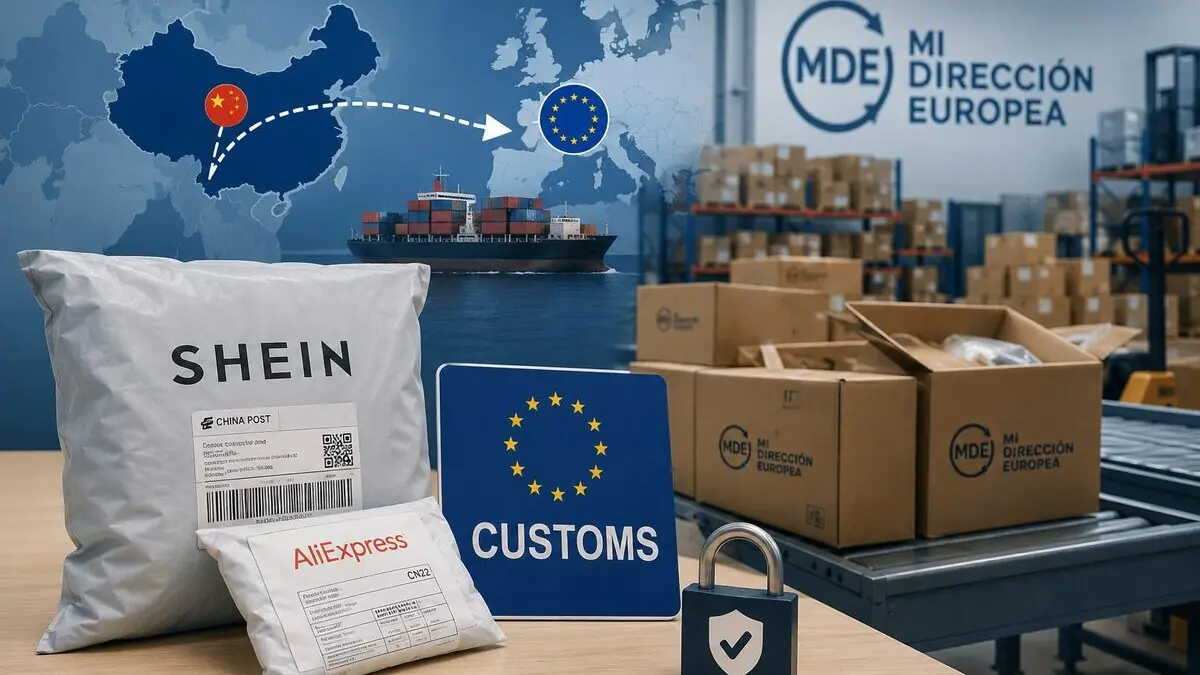
E-commerce between Europe and Asia is facing its biggest transformation in more than a decade.
Since 1 July 2026, the European Union has applied a comprehensive reform of its customs and tax regime, which will require all non-EU platforms —including Shein, AliExpress, Temu and TikTok Shop— to collect VAT at origin, declare the real value of products and subject every shipment to inspection or digital registration.
If you have not decided where to shop yet, the where to shop in Europe, the US and Asia lists hundreds of them by category.
In practical terms, this means the end of "no declared value" shipments, packages with fictitious invoices and the thousands of parcels that arrived in Europe without paying the real VAT.
European consumers now have to deal with more expensive products, customs delays and the inability to buy directly from certain Chinese stores.
But while the European Union tightens fiscal control, MDE offers a legal and effective alternative: turning European buyers into the prior owners of their goods at origin, through consolidation and shipping from its own warehouse in China.
Update (July 2026): the change is now official and in force. Since 1 July 2026, the EU has removed the customs exemption for parcels under €150 and applies a flat tariff of €3 per product category (the "Shein tax"), which can add up several times if a parcel contains items from different categories. The measure is provisional until 1 July 2028 and may be extended. The key exception: if the goods are already in a warehouse inside Spain or the EU, the tariff does not apply, and that is exactly where MDE's smart consolidation comes in.
The new landscape: Europe puts an end to the Asian "low-cost" model
Until now, the model of platforms like Shein or AliExpress was based on splitting up shipments.
Each order travelled as an individual low-value parcel, generally under €22, which made it possible to avoid VAT and import duties.
With the new customs control system, that is no longer possible.
Since July 2026:
A flat tariff of €3 per product category applies (the so-called "Shein tax"), and it can stack if a single parcel contains items from different categories.
All parcels coming from outside the EU will have to declare their value and pay the corresponding VAT, even if they cost less than €150.
The IOSS (Import One Stop Shop) will be extended to more product categories and to all marketplaces, including Shein and Temu.
Logistics operators will be required to submit digital information in advance of the parcel's arrival, making "anonymous shipping" impossible.
In short, European customers will no longer be able to freely receive Asian products without taking on tax costs and processing times.
MDE's proposal: ownership at origin and smart consolidation
MDE has designed an alternative that lets European buyers keep accessing Asian products at competitive prices, complying with the regulations while optimizing import costs and processes.
It works in a simple, though logistically advanced, way:
The European buyer gets a receiving address at MDE's warehouse in China.
They can shop on Shein, AliExpress, Taobao, JD or any Asian marketplace, sending the orders to that address.The goods arrive at the warehouse and are consolidated.
MDE groups the products together, generates a single set of documentation and a total value already declared as the customer's property.The shipment is sent to Europe as the customer's own goods.
The customer appears as the holder of the shipment, not as a retail buyer.
This simplifies customs clearance, and VAT or duties are applied only to the real consolidated base, not to each individual order.The result: average savings of 25% to 40%, reduced customs times and full transparency in traceability.
This model does not evade taxes: it optimizes them, turning the import process into a more efficient operation, in line with customs transit and prior-ownership regulations.
Case study: a European customer who cuts costs by 38%
Sofía lives in Lyon (France) and shops frequently on Shein and AliExpress.
Since July 2026, every order under €150 is subject to VAT, the new €3-per-category tariff and automatic review.
A batch of 10 items totalling €120 could end up costing more than €160 after applying fees and inspections.
With MDE, Sofía sends her orders to the Shenzhen warehouse.
There, the ten items are consolidated into a single shipment registered in her name.
Customs clearance is processed as a single private import, with a final total cost of €123 including transport.
The net saving is around 38%, and delivery arrives in 7 days, with no holds or additional formalities.
Why this model is legal and sustainable
The key to MDE's system lies in the concept of transfer of ownership at origin.
When the European buyer sends their purchases to the warehouse in China, the products already legally belong to them before the international shipment.
This allows the export to be registered as a personal shipment of one's own goods, not as a commercial operation by a foreign marketplace.
In addition:
Traceability and real-value declaration rules are met.
The hidden marketplace commissions are eliminated.
Transparency and cost planning before shipping are encouraged.
It is a model of logistics efficiency, not tax avoidance, backed by the standard practices of international forwarding and consolidation of personal goods.
A competitive advantage over the new European digital commerce
MDE is not just another shipping operator.
Its strength lies in its integrated logistics network between China, Hong Kong, Turkey and the main European countries (Spain, Germany, France, Italy and Czech Republic).
That infrastructure makes it possible to offer flexible routes, cost control and full support in Spanish and English.
In a context where European digital commerce is becoming more expensive and bureaucratic, MDE gives consumers back their freedom of choice, combining technology, customs expertise and human service.
The European customs reform of 2026 marks the end of the era of "no VAT, no control" Asian shopping.
However, the model proposed by MDE shows that it is possible to keep buying on Shein, AliExpress or Temu at competitive prices, without fraud and within the European legal framework.
The future is not about avoiding the rules, but about understanding them and adapting with logistics intelligence.
That is the real innovation: turning customs complexity into an opportunity for savings, control and efficiency for the European buyer.
Frequently asked questions about AliExpress and Shein tariffs in 2026
Do AliExpress, Shein and Temu charge customs duties in 2026?
Yes. Since 1 July 2026 the European Union removed the customs exemption for parcels under €150 and applies a flat tariff of €3 per product category (the "Shein tax"). Previously, low-value orders entered duty-free; now every parcel declares its real value and is taxed.
How much is the new AliExpress or Shein tariff?
€3 per product category and parcel. It is not a single charge per order: if one parcel contains items from different categories, the surcharge can add up several times. The tariff is provisional between 1 July 2026 and 1 July 2028, with the option to extend it.
Does the tariff also apply to orders under €150?
Yes. The old exemption that let purchases under €150 in duty-free is gone. Any shipment from outside the EU, regardless of its value, must declare its real value and pay VAT plus the new tariff.
Does AliExpress go through customs in Europe in 2026?
Yes. Logistics operators must submit digital information before the parcel arrives, so shipments are registered and can be inspected at customs. "No declared value" shipments are over.
How can I avoid or reduce the €3 AliExpress tariff?
It comes down to where the shipment starts. If the product is already in a warehouse inside Spain or the EU (filtering for "ships from Spain/EU"), the tariff does not apply. For items sold only from China, with MDE you can receive your purchases at our Shenzhen warehouse, consolidate them into a single shipment in your name and clear it as a personal import, optimizing VAT and duties and saving 25-40% on average.
Is it still worth buying on AliExpress or Shein from Europe in 2026?
Yes, if you shop strategically. Buying piece by piece is now more expensive because of the tariff and VAT. But consolidating several orders into one shipment (inside the EU or at origin) more than offsets the new cost, and you avoid customs holds and surprises.
Sign up today with MDE, get your international address and reship to the world with MDE. Enjoy a 14-day trial with a money-back guarantee. Our customer reviews are our greatest testament to quality and satisfaction.
Questions? Contact us. Our customer support team is ready to help you.