
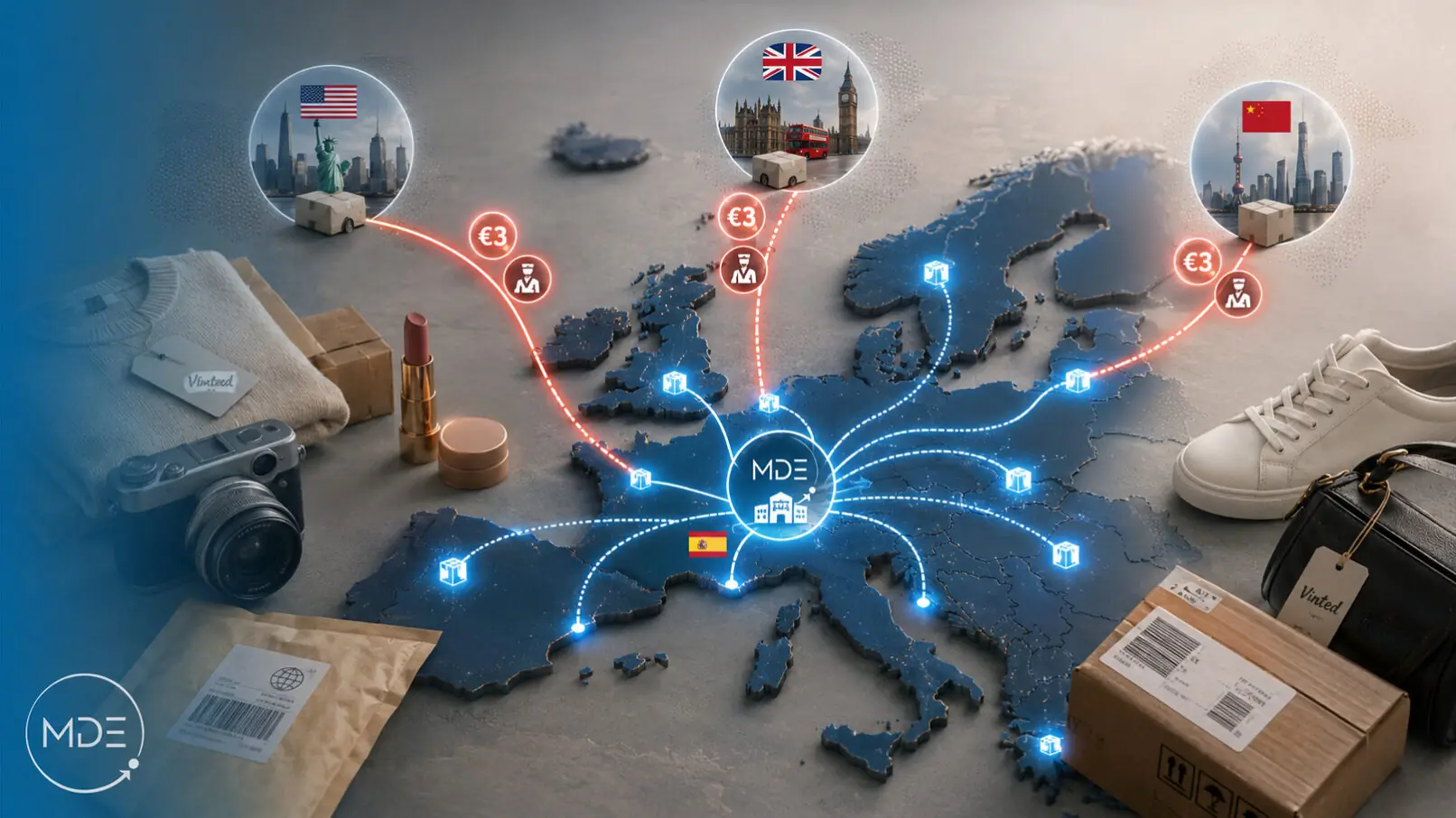
Since July 2026, buying from stores outside the European Union costs a little more. The EU removed the exemption that let parcels under €150 through duty-free and replaced it with a fixed duty. We explain where it comes from, who it really affects and -- most importantly -- how to keep shopping worldwide while paying less.
Quick answer
Since 1 July 2026, the EU applies a fixed duty of €3 per product category (tariff heading, not per parcel) to shipments under €150 entering from outside the Union, such as China, the United States or the United Kingdom. It's transitional until 2028. Consolidating doesn't eliminate it -- it's charged per category -- although grouping units of the same type reduces the number of charges. The way to avoid it: buy within the EU using an MDE European address, where the duty doesn't apply.
Where this duty comes from
It's not a fee invented by one country or a carrier surcharge. It's part of a customs reform across the whole European Union. Until now, parcels worth less than €150 entered without paying customs duties. That loophole fuelled direct-to-consumer shipments from Asian platforms: in 2024, more than 4.6 billion low-value parcels entered the EU, close to 12 million a day, and around 91% came from China.
To correct it, the EU removed that exemption and set a fixed, transitional customs duty of €3 per low-value shipment, in force since 1 July 2026 and expected to run until July 2028, while the new European customs system is finished. In addition, an extra €2 handling fee is being considered from November 2026, still pending confirmation.
The detail almost nobody explains well: it's per product CATEGORY
The charge is not per order or per parcel: it's per product category (per tariff heading). If a single purchase includes three different items, you don't pay €3: you pay €9. And note: if you return the product, that duty is not refunded, unless the item is defective or the contract is breached.
This is key to understanding why the solution isn't the one many people think.
So, does consolidating several parcels save it?
It depends, and here's the nuance almost nobody explains well. The duty is charged per product category (tariff heading), not per unit or per box:
- Several units of the same type of item, declared together, pay a single €3 charge (five T-shirts of the same class = €3). Here grouping does help.
- Products from different categories add €3 each (a T-shirt + a watch = €6), even if they travel in the same box.
In other words: consolidating reduces the duty when you combine more units of the same type, but not when you mix different products. And in every case it reduces the shipping cost: instead of five shipments, you pay one, with savings that can reach 70%.
How is it charged and who pays it?
The duty is settled in the low-value import customs declaration (H7), at €3 per declaration line, that is, per tariff category in the shipment. The party responsible for payment is the declarant (the seller, the IOSS-registered platform, the importer or their representative); in practice, the carrier or postal operator usually advances it and passes it on to the recipient. It's independent of VAT: they are separate concepts and can coexist in the same purchase.
About the proforma invoice: clearance relies on the commercial or proforma invoice, which documents contents, value and origin to classify the goods. But the €3 duty is fixed per category: it doesn't go down by declaring a lower value. Undervaluing the price or misclassifying the product to pay less is a customs offence. The only legitimate ways to pay less are buying within the EU (no duty) or grouping units of the same category.
How items are counted (and what you can legally do to pay less)
The number of €3 charges comes from the customs declaration, which is built from the invoice or proforma and the packing list that describe what's inside the shipment. It's not a figure you get to choose: it must reflect the actual goods.
The count is done by tariff heading (the 6-digit code) and origin:
- Several units of the same code and same origin, declared together, generate a single €3 charge.
- Each different code or origin adds a new declaration line and another €3.
Declaring your contents correctly and completely is good practice and helps make clearance quick and free of surprises. From there, what you can do to pay less, without stepping outside the law:
- Buy within the EU. It's the main lever: if the product is already in the Union, the duty doesn't apply.
- Group units of the same type. Bringing together several units of the same category and origin in one shipment makes them count as a single line, not one per unit.
A real example: the same cart, three ways to receive it
Imagine a cart of €89 with 4 items. Depending on how and where you buy it, the duty changes completely (the import VAT and the possible carrier fee are separate):
| Scenario | €3 duty | Why |
|---|---|---|
| A. 4 different products bought in China, direct entry | €12 (4 × 3) | Four tariff categories = four lines |
| B. 4 units of the same item, same origin, declared together | €3 | A single category = one line |
| C. The same product bought in an EU store with your MDE address | €0 | Intra-EU shipment: the duty doesn't apply |
Same product, same wallet, three results: €12, €3 or €0 of duty. The difference isn't in declaration tricks, but in where you buy and how you group. That's where MDE comes into play.
How MDE helps you pay less (for real)
Here's the useful part. The €3 duty only hits what enters from outside the EU. And that's exactly the point you can turn around with MDE:
1. Buy within the EU and the duty doesn't apply. With your MDE address in Spain, France, Italy, Germany, the United Kingdom or the Czech Republic, you buy from European stores as a local resident. When forwarding from one EU country to another, the movement is intra-EU: the €3 duty doesn't come into play. Very often the same product you were going to bring from China exists at a European seller.
And also:
- Consolidate to save on shipping. Combine several purchases -- from different stores and countries -- into a single shipment and cut the freight by up to 70%. It doesn't lower the duty, but it lowers the total cost.
- Group by product type. Since the charge is per tariff heading, buying several units of the same type of item can be more efficient than many different low-value products.
- Buy wisely. For items that only exist outside the EU, choosing fewer, higher-value products dilutes the duty's impact per unit.
- Advice and correct declaration. We help you declare correctly and choose the origin and route that cost you the least, with no surprises on delivery.
In summary
| Situation | Does the €3/product duty apply? |
|---|---|
| You buy in China, the USA, the UK or another country outside the EU (under €150) | Yes, per product |
| You buy from an EU store with your MDE European address and forward within the EU | Doesn't apply (intra-EU shipment) |
| You consolidate several units of the same type of product (same heading) from outside the EU | A single €3 charge for that category |
| You consolidate products from different categories from outside the EU | €3 per category (but you save on shipping) |
Buy in Europe and avoid the €3 duty
Get your address in 10 countries and buy within the EU like a local resident. We consolidate and ship it to your home.
Sign up and try 14 days with money-back guarantee. Have questions? Book a call with an advisor.Frequently asked questions
What is the EU's €3 duty?
It's a fixed, transitional customs duty that the European Union applies from 1 July 2026 to shipments under €150 coming from outside the EU. It replaces the old duty exemption for low-value parcels and will remain in force until 2028.
Is it paid per parcel or per product?
Per product: for each category or tariff heading within the shipment. If an order carries three different products, €9 is paid. It's not refunded if you return the product, unless it's defective or there's a breach.
Does consolidating my purchases avoid the duty?
No. Since it's charged per product and not per box, consolidating doesn't reduce the duty. What it does reduce, and a lot, is the shipping cost: up to 70% by combining several purchases into a single shipment.
How can I legally avoid the duty?
By buying within the EU. With an MDE European address you buy from EU stores and the forwarding is intra-EU, so the €3 duty doesn't apply. It only affects what enters from outside the Union.
Which purchases does it affect?
Those worth less than €150 entering from countries outside the EU, such as China, the United States or the United Kingdom. Also shipments destined for the Canary Islands, which are part of the Union's customs territory.
Does the United Kingdom pay this duty?
Yes. After Brexit, the United Kingdom is a third country. Shipments under €150 from the UK to the EU pay the €3 duty per category, just like those from China or the United States.
How is the duty settled and who pays it?
It's settled in the low-value import customs declaration (H7), at €3 per line or tariff category. The party responsible is the declarant (seller, IOSS platform, importer or their representative); in practice, the carrier or postal operator usually advances it and charges the recipient on delivery. It's independent of VAT.
Does declaring a lower value on the proforma reduce the duty?
No. The €3 duty is fixed per category and doesn't depend on the declared value. The commercial or proforma invoice is used to classify the goods and for VAT and the €150 threshold, not to lower the duty. Undervaluing or misclassifying the goods is a customs offence.
How are items counted for the duty?
By tariff heading (6-digit code) and origin, according to the customs declaration based on the invoice or proforma. Several units of the same code and origin add up to a single €3 charge; each different code or origin adds another €3. The count must reflect the actual goods: declaring it wrongly to pay less is an offence.
Is it the same if the parcel enters through another EU country instead of Spain?
The €3 duty and the H7 declaration are common EU customs rules: they apply the same way, with the same amount per category, in any country of entry. What changes by country is the import VAT (for example, Germany 19%, France 20%, Spain 21%, Italy 22%) and each carrier's handling fees. The duty is uniform; the final total cost depends on the country through which the goods enter.