
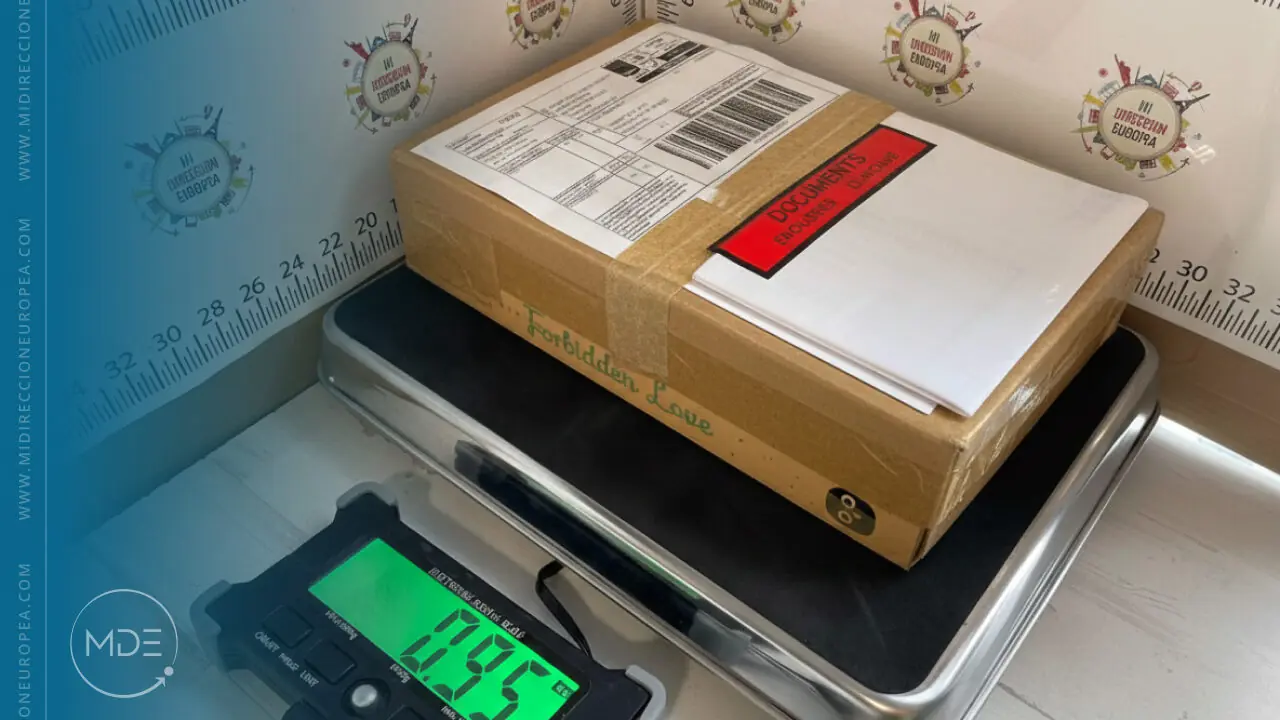
In international shipping, especially air freight, the cost does not depend solely on the parcel's actual weight. In many cases, the price is calculated based on the volumetric weight, that is, the space the goods take up. Understanding this difference is key to knowing when repackaging can generate real savings.
What is volumetric weight?
Volumetric weight is a calculation used by transport companies to determine how much space a parcel occupies in the plane or vehicle.
Common formula in air freight
Volumetric weight = Length×Width×Height / 5000(The divisor may vary depending on the carrier and the type of service.)
The chargeable weight will always be the greater of:
Actual weight
Volumetric weight
If the volumetric weight exceeds the actual weight, the shipment will be charged by volume.
The technical 1.3 rule: when to assess repackaging
Not every difference between actual and volumetric weight means it is worth intervening.
To avoid unnecessary decisions, a practical rule is used:
Volumetric weight > Actual weight × 1.3In other words, when the volumetric weight is at least 30% higher than the actual weight.
Why 1.3?
Differences of 5–15% are usually due to normal packaging.
30% or more usually indicates significant empty space.
It reduces false alarms.
It allows you to focus only on real opportunities.
This rule is not arbitrary; it is an operational threshold that balances efficiency and prudence.
Practical example
Let's assume:
Actual weight: 8 kg
Volumetric weight: 12 kg
We calculate:
8 × 1.3 = 10.4 kg
Since 12 kg > 10.4 kg, there is a significant difference.
In this case, it is reasonable to assess whether the packaging can be optimised.
When is repackaging usually worthwhile?
Repackaging may be advisable when:
1. The parcel is light but bulky
Clothing, textiles, accessories or padded products tend to generate high volumetrics.
2. The seller used an oversized box
Many shops use large standard packaging to simplify their logistics.
3. Several parcels are consolidated
Combining them can reduce costs, as long as the final space is optimised.
4. The shipment is international air freight
In this type of transport, the impact of volume is especially relevant.
When is repackaging not worth it?
There is not always room for improvement. It may not be advisable when:
The actual weight already clearly exceeds the volumetric weight.
The product is structurally large and cannot be reduced.
Handling it compromises the protection of the item.
The potential saving does not justify the intervention.
Optimisation should be based on technical analysis, not intuition.
Does repackaging always generate savings on international shipments?
Not necessarily.
For repackaging to be cost-effective, two conditions must be met:
There is a significant volumetric difference.
The reduction in volume makes it possible to move into a lower rate bracket.
Without these factors, the saving may be marginal or non-existent.
Additional benefits of repackaging
Beyond the possible saving, proper repackaging can:
Improve the protection of the contents.
Reduce the risk of damage.
Optimise consolidations.
Lower the number of later claims.
Optimisation is not only economic; it is also operational.
Conclusion
In international shipping, volume matters as much as weight.
The key is not to repackage every time, but to know when to do it. The 1.3 rule offers a reasonable technical criterion for spotting real opportunities.
Making data-driven decisions helps avoid unnecessary extra costs and improve logistics efficiency.
In international logistics, technical know-how makes the difference.
An optional service for those who want to optimise to the maximum
At MDE we understand that every shipment is different. That is why we technically analyse when there is a real opportunity for optimisation and offer, as an option, our repackaging service for those customers who want to reduce their transport costs even further.
It is not about handling parcels unnecessarily, but about taking care of the details when there is room for improvement. We assess each case with technical judgement and only recommend intervention when the potential benefit justifies it.
Because in international logistics, small adjustments can make a big difference.
Want to ship more efficiently?
If you ship internationally and want to optimise every detail —from volumetric calculation to consolidation and packaging—, we invite you to discover how we work.
Find out about our services and discover how to ship more intelligently.
Sign up today at MDE and turn the impossible into reality! Enjoy a 14-day trial with a money-back guarantee. Our customer reviews are our greatest testimony to quality and satisfaction.